Tuesday, October 16, 2018

Filipino Christmas Traditions (Learn Some Tagalog Words)

Being mostly Catholics, Filipinos start a novena (a series of nine masses) on December 16th. The masses are part of the religious tradition of Simbang Gabi, which literally means “Night Worship.”

Filipinos go to church at four o’clock in the morning and afterward have breakfast together. A traditional drink during this season is a warm ginger tea called salabat and a traditional treat is a flat but thick yellow rice cake called bibingka.

PASKO: Christmas in the Philippines

The Tagalog word Pasko derives from the Spanish word Pascua. Although the wordPascua means Easter, Pascua de Navidad refers to Christmas.
The Philippines is known for having the world’s longest Christmas season. The four months that end with the syllable –ber are considered Christmas months, which is why stores and households start playing carols on the first day of September! And the holiday season extends beyond December 31st. It doesn’t end until the Feast of the Epiphany or Three Kings (Tatlong Hari) which falls around January 6.


If Mexico has piñatas, the Philippines has its parol. Of course, a parol is not something to hit with a stick. It is a Christmas lantern, most commonly in the shape of a five-pointed star. The bamboo or rattan frame is covered with rice paper, tissue or cellophane. Almost every family either builds or buys one to hang by the window or door. Shopping malls construct giant versions of parol. Traditionally, a candle was placed inside for light to shine through; for safety reasons, people now use bulbs or even a flashlight.


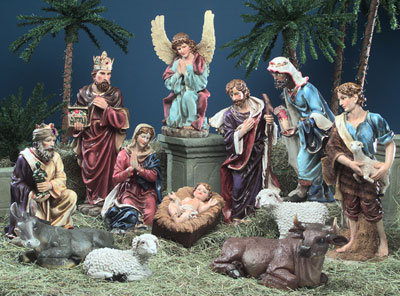
Families, schools and other places also display a creche or nativity scene called belen. Christmas trees made of plastic are decorated with lights, tinsel and balls.


The Tagalog word for gift is regalo, but Filipinos have a special word for “Christmas gift” — pamasko. Children receive fresh bills of money called aginaldo, usually when they visit their godparents and elderly relatives on Christmas morning.


Mostly Catholics, Filipinos begin a novena (a series of nine masses) on December 16th. The masses are part of the cherished religious tradition of Simbang Gabi, which literally means “Night Worship.” Filipinos go to church at four o’clock in the morning and afterward have breakfast together. A traditional drink during this season is a warm ginger tea called salabat and a traditional treat is a flat but thick yellow rice cake called bibingka.
What every Filipino looks forward to is Noche Buena, the grand family dinner after the midnight mass.


Christmas morning is the time for visiting relatives. Filipinos wear new if not their best clothes. Children do mano, which is kissing or bringing to their forehead the hand of an elderly person. This is when they receive their pamasko, certainly aguinaldo from godfathers and godmothers. Christmas lunch and Christmas dinner are with family.


Merry Chistmas!


Wednesday, October 10, 2018

The Cost of Dying: Funerals and Cemeteries


Presentation guideline:

We learned that both in Japan and the Philippines, there are many ways to remember the dead people in our lives. For many people, remembering the dead is a traditional part of life.

Ceremonies of remembering the dead often include extensive preparations, that are sometimes expensive. Also, cemeteries are likewise expensive to keep and maintain.

Some people believe that saying goodbye to dead loved ones should not cost so much money. Money is to be used for living people, not the dead. So, expensive funerals, and high cost of cemeteries are not practical.

However, some people believe that having lavish ceremonies for the dead is necessary, it is a way to say goodbye, and a way to show respect for the dead person. Cemeteries are needed, even if these are expensive, because there must be an official place where people can go and visit the remains of their dead loved one.

What about people who have no relatives, how will they be remembered? Will you be willing to pay for the funeral and a space in a cemetery for someone you don’t know? What do you think can be done for people like this?

What is your opinion about remembering the dead? Do some research, and give supporting facts about your opinion.

Wednesday, October 3, 2018

How Japanese people celebrate Obon

In Japan, Obon is often a solemn occasion, with visits to the cemetery, going to hometowns and meeting relatives.

How do you celebrate Obon? Compare Obon, with the Philippines’ Undas.


Videos:

Japan's OBON Festival: Invitation for the Dead

Learn Japanese Holidays: Obon

The Japanese Tradition (A Funny Look at Obon) 日本語版

Wednesday, June 27, 2018

Tourism in the Philippines: Statistics

City of Manila


Manila City skyline view from Harbour Square

Makati City


Makati City skyline

Tourism is an important sector for the Philippine economy, contributing 7.8% to the Philippine gross domestic product (GDP) in 2014.[2]
Philippines is an archipelagic country composed of 7,107 islands with 82 provinces divided in 18 regions. Philippines is known for having its rich biodiversity and it is the main tourist attraction in the country.[3] Its beaches, mountains, rainforests, islands and diving spots are among the country's most popular tourist destinations. The country's rich historical and cultural heritage is also one of the attractions of the Philippines.
Popular destinations among tourists are El Nido in Palawan, Boracay, Cebu, Manila and many more.
 
 
Since 2010, South Korea has been the largest source of visitors to the Philippines. In 2013, a total of 1.17 million South Koreans visited the Philippines. It is followed by the United States, Japan, China, Australia, Taiwan, and Canada.[5] In 2013, the country attracted 4,681,307 visitors.[5]
In 2014, the Department of Tourism announced that the year 2015 will be the Visit the Philippines year.

Arrivals

Tourism Statistics[20]
YearForeign
Tourists
19961,049,367
19971,222,523
19981,149,357
19991,170,514
20001,992,169
20011,796,893
20021,932,677
20031,907,226
20042,291,347
20052,623,084
20062,843,335
20073,091,993
20083,139,422
20093,017,099
20103,520,471
20113,917,454
20124,272,811[21]
20134,681,307[22]
20144,833,368[23]
20155,360,682[24]
Jan-Feb 20161,091,983[25]

Top 20 international visitors

RankCountryJan-Feb 201620152014201320122011
1 South Korea284,7631,339,6781,175,4721,165,7891,031,155925,204
2 United States155,796779,217722,750674,564652,626624,527
3 China130,916490,641394,951426,352250,883243,137
4 Japan92,531495,662463,744433,705412,474375,496
5 Australia43,712241,187224,784213,023191,150170,736
6 Canada36,773156,363143,899131,381123,699117,423
7 Taiwan35,344177,670142,973139,099216,511181,738
8 Singapore28,376181,175179,099175,034148,215137,802
9 United Kingdom28,238154,589133,665122,759113,282112,106
10 Malaysia23,990155,814139,245109,437114,51391,752
11 Hong Kong122,180126,008114,100118,666112,106
12 Germany75,34872,80170,94967,20361,193
13 India74,82461,15252,20646,39542,844
14 Saudi Arabia50,88443,48338,96930,04027,945
15 Indonesia8,82448,17846,75745,58236,62734,542
16 France12,50245,50538,94639,04233,70929,591
17 Thailand44,03845,94347,84740,98737,862
18 Russia35,37838,97641,25433,72923,908
19 Guam35,262
20 Vietnam31,579


Reference:

https://en.wikipedia.org/wiki/Tourism_in_the_Philippines

Reading Comprehension and Wrting

Based on our reading - Why Japan's Universities continue to Fall in Global Rankings - please answer the following questions on the paper provided.

1. What does THE stand for?
T __________________ H___________________ E__________________

2. What did Prime Minister Shinzo Abe propose in 2013, related to education?

3. What were the 5 categories on which the THE based their ranking?

4. What were mentioned as the six leading universities in Asia?

Essay:

1. According to the article:
"The recent rapid decline of Japanese universities's rankings is attributable to major strides made by their counterparts in Singapore, China and South Korea." Do you agree or disagree with this statement? Explain your answer.

2. The last three paragraphs of the article writes about the three problems with the current THE World University Rankings, Choose ONE problem, and explain how this affects the ranking of Japan.

Wednesday, June 6, 2018

Presentation Tips

This link will give you tips about making a good PowerPoint presentation. The file is a PowerPoint file and may have to be downloaded.


Opnion Essays

Link to Slide (How to Write an Opinion Essay)

http://www.slideshare.net/aponce4/an-opinion-essay-presentation

Tips on Writing an Opinion Essay:

http://homeworktips.about.com/od/essaywriting/a/opinion.htm


Fact vs Opinion YouTube link:
http://youtu.be/fnFnWWAnlkw

https://www.youtube.com/watch?v=LAKprpl7aPo

Advanced Opinion Writing
The most important way to persuade someone to agree with what you are writing is to include strong supporting facts. Your writing will always sound better when you support what you have written with evidence or good examples.

A second way to persuade someone to agree with the ideas in your writing is to include at least one sentence with an opposing opinion (an opinion that disagrees with your point of view). At first, this might not seem like a good idea, but it is common to state one point of view that disagrees with your own point of view. This is called a counterargument. This counterargument is then followed by a statement that refutes, or reduces the counterargument. This is called a refutation because you refute the counterargument.

When you acknowledge this other opinion, you should downplay, or minimize it. One way to do this is to use weak words, such as some, may, and might, as we can see in the following example:

                 Some people might say that uniforms take away personal freedom, but students still have
                 many other ways to express themselves and their individuality.

In a good opinion paragraph, the writer:

  • states an opinion about a topic
  • provides supporting sentences with factual information
  • briefly mentions one opposing point of view (the counterargument)
  • refute the counterargument in one or two sentences (refutation)
  • finishes the paragraph with a concluding sentence that restates the topic sentence and / or offers a solution.

Read the paragraph above and answer the following questions:
1. What is the opinion of the writer about high school students volunteering? ___________________________________________________________________________

2. What is the counterargument sentence? ___________________________________________________________________________

3. What is the statement that refutes the counterargument?
___________________________________________________________________________

4. What are the supporting facts?
___________________________________________________________________________

5. What is the concluding sentence?
___________________________________________________________________________