Wednesday, October 16, 2019

Celebrating Halloween in the Philippines

Celebrating Halloween, the Filipino-style

Called “undas” in Filipino.

Halloween in the Philippines is not like the Halloween in the Western countries. Although it’s a big holiday (comparable to Christmas here), we celebrate it in a different manner. Halloween in the Philippines lasts from the eve of October 31 (or even before this day) to November 2. Due to our strong Catholic background, Nov. 1 and Nov. 2 are spent remembering our dead loved ones and these dates will usually find most of us in one place only: the cemetery or the memorial park.
This is a hub on how the Filipinos celebrate their Halloween. No, we don’t celebrate it with pumpkins or trick-or-treats (although this Western tradition is sometimes practiced in some families / subdivisions here). We celebrate it through candles, flowers, prayers and a visit to the cemetery.

What Happens During the Halloween

The following are the chain of events during the Halloween celebration:
A week before October 31: This is the start of the clean-up of cemeteries and the graves of the loved ones. The graves get fresh paint, grasses are cut, floors are swept and everything is made ready for the visits on Nov. 1 or 2.


A few days before November 1: People from the capital and other places in the Philippines start going back to their hometowns (or what we call the provinces) to visit their dead loved ones. During these days, the airplanes / airports are packed, so are the ships and the buses. The height of this “travel season” is on October 31, where employees take the whole day off to catch the last bus (or ship or plane) for their way home.

The eve of October 31: The people are already busily preparing for the next day. All the items (such as candles, flowers and snacks) that will be brought to the cemetery the following day are already purchased and packed by this time.


November 1: Also called All Saints’ Day. It may be for the saints but here, it is definitely a day to remember the souls. The cemeteries and the memorial parks are overflowing with people during this day, especially in the afternoon or even the evening. Traffic going in and out of cemeteries and on the nearby streets is pretty tight. Policemen and other law enforcement agencies are on heightened alert during this time to ensure that the activities during this day are peaceful and are done in an orderly fashion.

November 2: This is actually the All Souls’ Day. For some people who do not want to brave the crowds on Nov. 1, they opt instead to go to the cemeteries on Nov. 2 (less noisy and more somber this way). But for a lot of people, their trips back to their workplace or to the cities start on this day.
Okay, you might think we have a very boring Halloween here. I mean, cemeteries, graves, prayers, etc. make it look like a serious affair. Not so. Spending Halloween in the cemeteries is a fun event. It’s like a mini-reunion for families and friends alike, a chance to have fellowship with those people that we see only once a year (only on Nov. 1 of each year). Tents, shelters, chairs and tables are set up in front of the grave sites to provide a place where the family and their visitors can stay and talk. Radios, mp3s, CD players, musical instruments, karaoke and the like are present to provide music, singing and entertainment. Board games, playing cards, play stations are also present for the young ones (and the young at heart). Best of all, food and drinks are overflowing during this time, with families bringing in baskets of food and drinks to share with other members of their families and their visitors.
If you run out of food, drinks, candles and even flowers, vendors are all around the cemetery to provide for your needs. It saves the family members the hassle of bringing these things plus it provides extra income for these vendors.
There you have it. Halloween Filipino – style. Different, yes, but equally as interesting as the Halloween celebration in other parts of the world.

Wednesday, October 9, 2019

Festivals and Their Importance to the Filipinos


Festivals and Their Importance to the Filipinos
by Ethnic Groups Philippines

24 January 2016
Cebu City – The start of 2017 is celebrated with festivals left and right–from the Feast of the Black Nazarene in Manila, to the Sinulog Festival in Cebu, and to the Dinagyang in Iloilo, to name a few. Almost every province and city in the Philippines has all kind of fiestas celebrated all year round that shows the rich culture of the country. This practice has been embedded in the Filipino tradition and believed to have started even before the coming of the Spaniards.
There are different types of festivals, namely, religious, national, or seasonal. A considerable number of festivals celebrated in the country are of religious origin, honoring the city or province’s patron saint. A mass, novenas, grand parade, beauty pageants, processions, and many other activities are prepared for this special day that brings all the whole community together to express gratitude to God. Often, such occasions draw many balikbayans to return home and reminisce the olden times.

Before the coming of the Spaniards, Filipinos practiced animism, or the worship of spirits, which involved performing ceremonies intended to appease malevolent spirits. These spirits are believed to control parts of human life, such as health, wealth, family, and subsistence. To ward off misfortunes and gratify these spirits, ritual offerings are regularly made by the locals.  Catholic missionaries who arrived along with the Spaniards created fiestas to gradually persuade the population to convert to the Roman Catholic faith.

Today, the Philippines is the only predominantly Christian country in all of Asia. The practices taught by the Spanish clergy have merged well with indigenous ritual practices and carried over to this day. Philippine festivals are celebrations to express gratitude for a good harvest in honor of the town’s patron saint. Filipinos, especially those living in provincial areas, go all out to celebrate this festivities to guarantee comfort in the coming year, believing that the bigger they spend, the more returns they will obtain.
For many Filipinos, fiestas are important because of the miraculous power of the saints. It is believed that the saints are responsible for all the good fortune and favor one receives. More than that, it is also during this time that the locals get to celebrate their culture and traditions that are passed on to the next generation. Fiestas reflect Filipino religion and faith, which are the most essential part of society. Nowadays, however, a distinguishing cultural aspect that is unique to the community is preferred as a central subject for many celebrations.

Among the famous festivities in the country are the Feast of the Black Nazarene in Quiapo, where thousands of barefoot men join the procession of the Black Nazarene; the Sinulog festival in Cebu, which is celebrated with a long parade and different dances in honor of the Santo Niño; and the Dinagyang Festival in Iloilo, which is characterized by a colorful parade to honor the Holy Child Jesus and commemorate the Christianization of the natives.

The Filipinos are mostly religious people, no matter what beliefs we hold and religious affiliations we have. The church and our faith have always been our pillars of strength and highly regarded by the people for support or guidance. Festivals are reminders of our past; it gives us a glimpse of our rich cultural heritage and at the same time connects us to our families and loved ones.


Wednesday, July 17, 2019

Interview with Jose Rizal manga creators

Takahiro Matsui on why he wrote the manga:


Mang artist Ryo Konno on making Jose Rizal the manga:


Spring 2019 Class Plan


Week

TOPIC

ACTIVITY

NOTES

Week 1

Class Discussion: About the Philippines

Orientation, general introduction about the class. 

Week 2

Festivals
Class discussion


Week 3

The Importance of festivals

Using Powerpoint 

Class discussion
Plan a presentation
Week 4


Presentation

Read and understand the blog entry:

Matsuri: The best summer festivals in Japan for 2019
Week 5

Summer Festivals in Japan

Participating in international
festivals.


Discussion

Topic: Opinion festivals

*35th Philippine International Festival in Nagoya at the Nagoya International Center
May 26, 2019 (Sunday)
Week 6


Watch video, and discuss in class
https://www.youtube.com/watch?v=WK4gOpO0z3c
Handout about Festivals

Write a report
Week 7

Best Cities in the Philippines

Report Writing / Submission
Handout for Best Cities in the Philippines


Week 8

Talk about one city
Presentation

 
Week 9

Current Events
Watch internaional news cites about the Philippines
(English or Japanese)
Choose an interesting news report about the Philippines.
Week 10

Writing


Discuss the manga
https://youtu.be/IvzlbAd2SUc
Week 11

Topics for final presentation
The Life of Jose Rizal

Planning the class presentation:

4-part documentary
Rizal's young life
Rizal's experience in travelling around the world
Rizal's life as a doctor
Rizal as a national hero of the Phiippnes


How to make a documentary
Week 12

 Planning/Research
Record the video:
use an iPhone or iPad, edit with iMovie if needed
Week 13

Prepare the documentary
Finalize documentary video, make sure everything is done.
Writing activity:
summary of documentary information
Week 14

Submit / Present final activity
Show video in class
Week 15

Consultation / Advice


Jose Rizal on Manga

https://www.manga.club/jose/
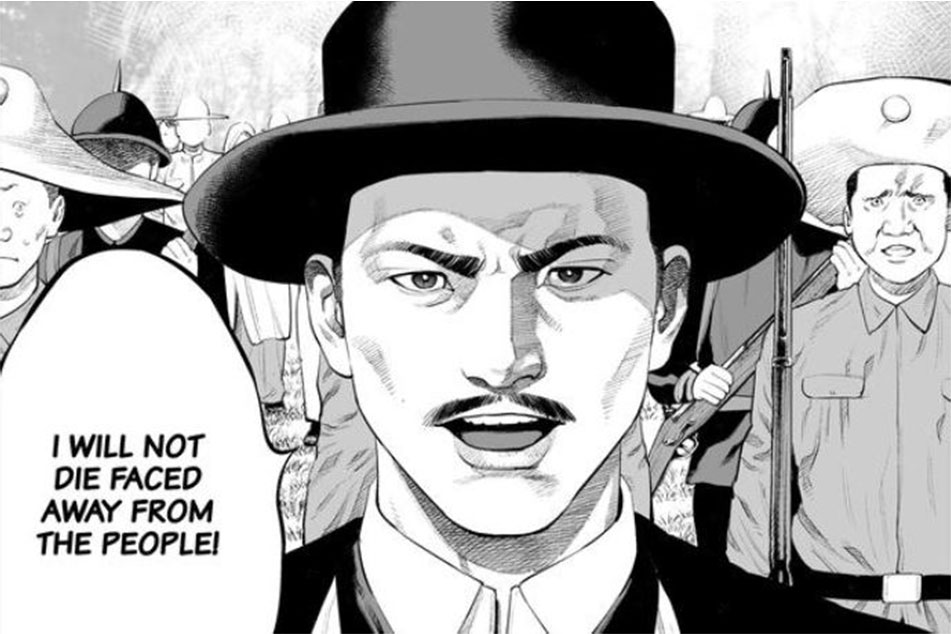
He's the most famous Philippine hero who has statues honoring him long after his death across the world, including one in Japan. And now, Jose Rizal has been immortalized in manga form.
Out today -- Rizal's birth anniversary -- and available online for free, "Jose Rizal" adapts the life of the legendary Filipino figure and tells of how he inspired a national revolution against the Spanish rule. 
Publisher TORICO said this is the first manga written about Rizal. The short first chapter opens with his execution in Bagumbayan, and ends with a young Rizal witnessing the arrest of his mother. 
From the manga https://www.manga.club/jose/
In an interview with CNN Philippines, TORICO representative Takuro Ando shared that the inspiration behind the original manga stems from his curiosity on why Rizal had a statue in Tokyo. 
He described Rizal as a genius "who had changed his country not through violence but through his knowledge and hard work." 
Rizal stayed in Japan for 45 days in 1888 and was said to have been charmed by the country's natural beauty and its people, prompting him to study its culture and traditions. During his sojourn, he fell in love with a Japanese woman named Seiko Usui.
Matsui Takahiro, who, according to reports, had worked in the Philippines before, wrote the storyline, while Ryo Konno was in charge of the illustrations.

The Life of Jose RIzal

Jose Rizal is the National Hero of the Philippines. Find out more about his life from the reading and  links provided:

José Rizal Biography

Doctor, Journalist, Poet (1861–1896)


José Rizal called for peaceful reform of Spain's colonial rule in the Philippines. After his 1896 execution, he became an icon for the nationalist movement.

Synopsis

José Rizal was born on June 19, 1861, in Calamba, Philippines. While living in Europe, Rizal wrote about the discrimination that accompanied Spain's colonial rule of his country. He returned to the Philippines in 1892, but was exiled due to his desire for reform. Although he supported peaceful change, Rizal was convicted of sedition and executed on December 30, 1896, at age 35.

Early Life

On June 19, 1861, José Protasio Rizal Mercado y Alonso Realonda was born in Calamba in the Philippines' Laguna Province. A brilliant student who became proficient in multiple languages, José Rizal studied medicine in Manila. In 1882, he traveled to Spain to complete his medical degree.

Writing and Reform

While in Europe, José Rizal became part of the Propaganda Movement, connecting with other Filipinos who wanted reform. He also wrote his first novel, Noli Me Tangere (Touch Me Not/The Social Cancer), a work that detailed the dark aspects of Spain's colonial rule in the Philippines, with particular focus on the role of Catholic friars. The book was banned in the Philippines, though copies were smuggled in. Because of this novel, Rizal's return to the Philippines in 1887 was cut short when he was targeted by police.
Rizal returned to Europe and continued to write, releasing his follow-up novel, El Filibusterismo (The Reign of Greed) in 1891. He also published articles in La Solidaridad, a paper aligned with the Propaganda Movement. The reforms Rizal advocated for did not include independence—he called for equal treatment of Filipinos, limiting the power of Spanish friars and representation for the Philippines in the Spanish Cortes (Spain's parliament).

Exile in the Philippines

Rizal returned to the Philippines in 1892, feeling he needed to be in the country to effect change. Although the reform society he founded, the Liga Filipino (Philippine League), supported non-violent action, Rizal was still exiled to Dapitan, on the island of Mindanao. During the four years Rizal was in exile, he practiced medicine and took on students.

Execution and Legacy

In 1895, Rizal asked for permission to travel to Cuba as an army doctor. His request was approved, but in August 1896, Katipunan, a nationalist Filipino society founded by Andres Bonifacio, revolted. Though he had no ties to the group, and disapproved of its violent methods, Rizal was arrested shortly thereafter.
After a show trial, Rizal was convicted of sedition and sentenced to death by firing squad. Rizal's public execution was carried out in Manila on December 30, 1896, when he was 35 years old. His execution created more opposition to Spanish rule.
Spain's control of the Philippines ended in 1898, though the country did not gain lasting independence until after World War II. Rizal remains a nationalist icon in the Philippines for helping the country take its first steps toward independence.

Fact Check

We strive for accuracy and fairness. If you see something that doesn't look right, contact us!


Other Links:

https://youtu.be/rI0dK7uy__E

https://www.facebook.com/111131982293260/videos/jos%C3%A9-rizal-full-movie/1212051558867958/ (This is a movie and might not be all in English)

https://www.manga.club/jose/ (This is a manga of the life of Jose Rizal, story by Takahiro Matsui, art by Ryo Konno)


Wednesday, June 5, 2019

10 Best Places to Live in the Philippines

Reference: https://theculturetrip.com/asia/philippines/articles/the-10-best-places-to-live-in-the-philippines/

Baguio City
The City of Pines (also known as the country’s Summer Capital) is known for having a cooler climate as compared to the majority of the provinces in the country. With that, fruits and vegetables are always fresh and walking from one establishment to another isn’t a problem. Because of its calm and cool ambience, it seemingly puts residents into a good mood at all times. While commercialization is definitely obvious and heavy traffic builds up every now and then, Baguio City preserves its charm, laid-back atmosphere, art scenes, and of course, the stunning, nature attractions.
 
Tagaytay City
When it comes to spur-of-the-moment out of town trips, Tagaytay is always a common top choice among travelers. That’s because it only takes less than two hours from Manila to reach this destination. Whether it’s a trip with the significant other, a group of friends, or a vacation with the whole family, the numerous leisure and outdoor activities definitely won’t disappoint. Apart from the cool temperature and its close proximity to Metro Manila, current major developments are also focused within the area. And unlike Manila, majority of the land area is covered in greens, thick smog is nowhere to be found, and the breathtaking view of Taal Lake will always leave you in awe.

Lipa City, Batangas

If you’re a beach bum who loves peace and quiet, you won’t get enough of the stunning, picturesque beaches in the province of Batangas. Whether it’s fine white-sand beaches or rocky shores, Batangas has various beach resorts perfect for solitude-seekers. The province also caters to newbie hikers and climbers because of its hiking and mountain climbing destinations. If you’re considering to move to Batangas, Lipa City is said to be a top choice especially among retirees because of its cooler climate and ideal location – being close to nature’s best attractions and convenient travel to the country’s capital, Manila.

Sta. Rosa City, Laguna

Apart from being home to various historical spots, nature parks, hot springs, and popular theme park Enchanted Kingdom, major commercialization developments are focused within the suburbs of Laguna. And, if you’re someone who’s looking to move within an areas of greens yet provides accessible modern comforts such as food parks, malls, and other commercial establishments, the booming area of Santa Rosa City is a perfect choice. What was once a vast fields of greens has developed into a conducive, family-friendly environment characterized by open spaces and rich natural surroundings while offering retail centers for residents’ everyday needs.
 
Subic, Zambales
Renowned for being a former US naval base, Subic has also become a popular tourist attraction among adventure-seekers because of thrilling rides, diving areas for shipwrecks and coral species, and wondrous beaches. While its famous among families or those traveling in groups, Subic area is also a sought-after residential spot for offering both rural and urban living. Even if it’s four hours away from Metro Manila, it has unique shopping and dining options and the best part is, one can drive around safely because traffic rules are strictly implemented.
 
Makati City
Amidst the horrendous situation of Manila traffic, business-capital Makati City is a standout city in the country’s National Capital Region. Apart from offering everything that one needs within the vast commercial and business establishments, both home seekers and investors are keen to invest in this area. For home seekers, top-quality condominiums are available and thus, provides convenience for those who work around the area and prefer to enjoy the city life. Plus, Makati’s government is known to strictly implement security and traffic rules which guarantees one’s overall safety.
 
Cebu City
Being the Visayas Region‘s main business hub, Cebu boasts the perfect combination of both urban and natural attractions within one’s reach. One can easily immerse in good food, entertainment, rich culture, and world-class beaches such as those in Malapascua, Sumilon, and Bantayan within a short distance. Apart from being the location of the grand Sinulog Festival and being home to famous native delicacies, there’s a number of growing economic centers and industries for those seeking new career opportunities. In addition, Cebuanos are also generally well-known to be accommodating individuals.
 
Bacolod City
Bacolod City has been dubbed twice as the Philippines’ best place to live in by two separate magazines in the years 2008 and 2017. This comes as no surprise because it offers amenities like that of a highly-urbanized city but only better – a cleaner and greener environment, absence of traffic woes, and a lower cost of living. It’s also home to the most delectable cuisine where restaurants, pastry shops and fine dining restaurants give one a taste of how the sweet life is like in the city found within the country’s Sugar Bowl Capital. Bacolod City is also known as ‘The City of Smiles’ and that’s because its charming locals are known for their warmth and hospitality.
 
Iloilo City
Being one of the highlights of Panay Island, Iloilo City is dubbed as the ‘jewel’ of the Western Visayas. This close neighbor of Bacolod City is also home to genuinely kind people and also has a highly-urbanized setting while fostering a relaxed atmosphere. There are only a few traffic jams experienced within this city and so, it’s expected that locals here are happier. Apart from the Dinagyang Festival (which is the city’s biggest cultural and widely-celebrated festival), hitting the beaches and island-hopping are right outside the city as it’s near the islands of Boracay and Guimaras. They also have bike-friendly lanes, an esplanade ideal for relaxing late afternoon walks, and heavenly seafood restaurants!
 
Davao City
Davao City is considered as one of the most livable and safest cities in the world primarily because of its low crime rates and strict enforcement of discipline and order by its local government. It has a centralized communication in providing emergency responses to its residents. And because Davao City is easily accessible via land, sea or air travel, it’s no wonder that it has also become a business hub and a regional center in southern Philippines. As one of the fastest developing cities, the local government has its full support in ensuring that public utilities and infrastructures are well-maintained.